

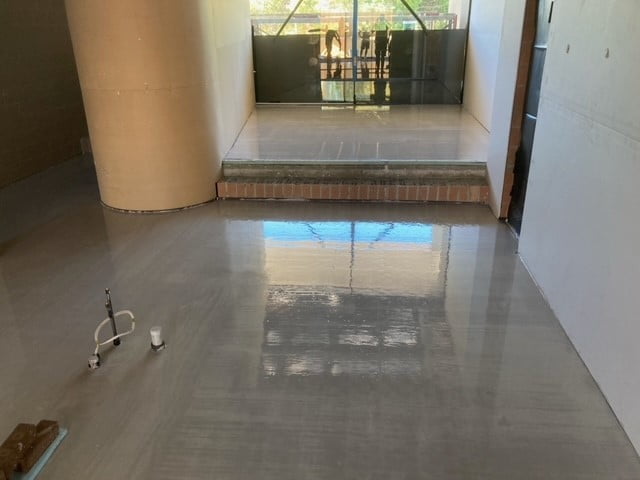
If you are modernising your residence, there is a strong likelihood that you might be smitten with the idea of large-format tiles. Be it 1200mm porcelain floors and walls or natural stone tiles, the end result is a breathtaking “glass finish” that gives the illusion of a much larger space.
The challenge, however, is that as tiles increase in size, their “forgiveness” levels decrease. Even a minute 2mm variation in your subfloor could result not only in tiles breaking, but also lipping, which is a point where one tile’s edge is raised above another. In our opinion, at Top Mix Ltd, it is not simply a question of carrying out flawless tile work; it is actually all about what lies beneath. As experienced suppliers of self levelling screed across Cheltenham, our team is accustomed to assisting with large-scale residential projects, and a perfect flat surface is what will guarantee your investment is safeguarded.
Why “Flat” And “Level” Aren’t Exactly The Same Term
This is a misleading mistake in the construction industry. You can have a level floor but not have a flat floor. Then there are “waves” in traditional concrete floors. When placing a small mosaic tile, the waves can be covered up.
However, large-format tiles have a hard surface on the back. If it spans a depression in the concrete, a gap occurs. As soon as you step on it, the pressure forces the tile to crack. We fill these gaps using levelling compounds to ensure 100% contact between the surface and the adhesive.
The Technical Edge: Achieving Sr1 Standards
In the industry, the surface flatness is calculated by the “Surface Regularity” (SR) classes. In luxury tile installations, it is always best to aim for SR1, the highest standard, which has no tolerance beyond a variation of 3mm over a 2-meter straight edge.
How we do this for you:
- High Flowability: Our self-levelling screed has been designed to act as water would, flowing towards the lowest areas of the room.
- Rapid Setting: Most of our mixes are ready for foot traffic within a few hours.
- Precision Preparation: What most installers are only pouring, we are determining your subfloor’s moisture levels and porosity.
Compatibility With Modern Heating
Many households are currently using thin electric mats for underfloor heating. It is hard to lay a normal sand and cement compound over such thin wires, and this results in “hotspots” that can compromise this type of installation.
A self-levelling system that requires pumping has the ability to flow easily around the elements so that they are fully enclosed. Not only does this provide adequate protection for the wires, but it also ensures that the heat conduction is enhanced, so that your floor gets warmed faster and stays warmer for longer. We have noted that it has become the method of choice for energy-efficient buildings, just like our liquid screed in Aylesbury, which has become the popular choice for larger installations involving water-based heating systems.
Professional Tips For A Flawless Pour
To achieve the “glass finish” each time, remember the following three things:
- The Primer is Key: Never pour onto a dusty, raw slab. We are always extremely keen on using a good primer to stop the subfloor from “sucking out” the moisture from the screed.
- Mind the Expansion: Very much like the tiles themselves, screed requires the smallest amount of leeway. We add expansion strips around the edges to stop the screed from cracking and shrinking.
- The Dapple Effect: While the product is self-levelling, our technicians follow this up with a dappling bar to interrupt the surface tension and remove any air bubbles.
Ready To Level Up Your Project?
Let us prevent an uneven subfloor from undermining a dream kitchen or bathroom. As either a do-it-yourself individual in search of expert guidance or a contractor in need of high-volume pumps, Top Mix Ltd is there for you.
Need a quote? Talk with our technical expert today about your flooring specifications. Call us on 01865 660006.