

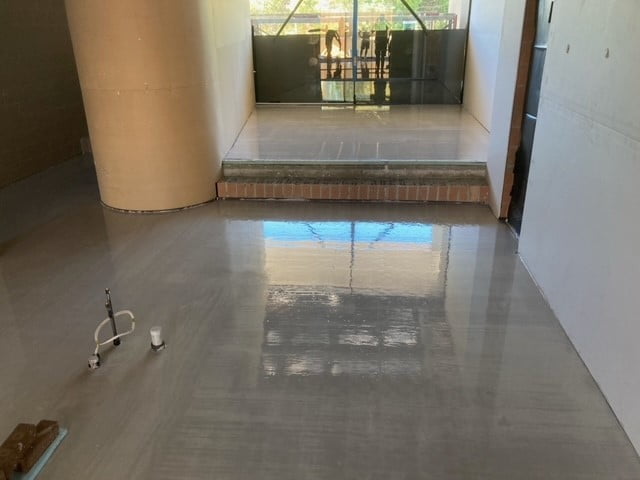
Moisture becomes a factor the moment we mix and pump the screed. Liquid screed arrives on site ready to flow. It fills every gap and creates a smooth base in one continuous pour. Water is an important part of that mix.
Why Pumped Screed in Newbury Needs Precise Drying Validation
Newbury sites often feature tight schedules and variable weather. We supply pumped screed in Newbury for both residential extensions and larger commercial floors. The calcium sulphate formula we use offers excellent flow and thermal properties. It pairs perfectly with underfloor heating systems. Yet this same material holds onto moisture longer than many expect.
Drying validation becomes essential here. We insist on it because Newbury projects frequently move from screed pour to final floor finish in under four weeks. Without checks, installers risk overlaying too soon. The thinner profile of our liquid screed speeds initial set but leaves deeper moisture pockets intact. Precise testing confirms when the entire depth reaches safe levels. Skipping this step can bring the exact failures we discuss. At Top Mix Ltd, we guide clients on the validation process that protects their investment.
Critical Mistake: Applying Levelling Compound in Bristol Too Early
Contractors sometimes apply a separate levelling compound in Bristol over the base screed to correct minor undulations. This step seems harmless. In reality, it seals in any remaining moisture from the pumped layer below.
We see this mistake surface in Bristol projects where timelines are tight. The levelling compound cures on top and appears stable. Beneath it, the original screed continues its slow release. Moisture migrates through the fresh compound and attacks the adhesive applied next. The bond breaks down from the inside. Vinyl bubbles form in patches. Tiles lift at the grout lines. The failure looks random until we trace it back to that early overlay.
At Top Mix Ltd, we stress timing above all. Pumped screed in Newbury and levelling compound both demand full drying before the next layer. Rushing this stage turns a strong system into a liability.
Once moisture levels drop, we retest using both the CM and hygrometer methods. Only then do we approve a new levelling compound or direct floor finish. In some cases, a compatible primer creates an extra barrier. The goal is to restore the system so moisture can never interfere again.
Our experience shows that proper recovery returns floors to full strength. The same principles apply when levelling compound in Bristol forms part of the build.
We stand ready to support your work with quality pumped screed and expert insight across the region. Test first. Install once. Call us.